|
Our history does not date from ancient times, as that of certain peoples whose origins are lost in the mists of time. The birth of the Acadian people can be determined very precisely to the first half of the 17th century, as pioneers, coming mainly from the western provinces of France, but also from the Basque country, from Flanders and elsewhere, established themselves on the shore of what they called the Baie Française, now the Bay of Fundy, and formed the first white community in North America. Peaceful, living in harmony with the native populations who were their neighbours, they gave their new country the name Acadie, which is still printed indelibly in our hearts.
Very soon, after only a few generations, they considered themselves as a distinct people, refusing to bear arms in the wars that went on incessantly, or so it seemed, between the French and the English over the possession of their homeland. All they asked was to live in peace.
But those who wage war look suspiciously upon those who do not take part in their deadly games. A century and a half after their installation on the territory, the Acadians were victims of a deportation order which dismembered their population and robbed them of the lands that they farmed successfully, thanks to an ingenious irrigation system.
Outlawed, dispersed to the four winds or condemned to a life in hiding, they remained silent for many long years; then, timidly at first, then more and more openly, they rebuilt a new country on the ruins of old Acadie. Their original lands were no longer theirs; but they dispersed over the areas left over by the new masters and patiently recreated a living Acadie, which has no official status, but asserts itself more and more resolutely.
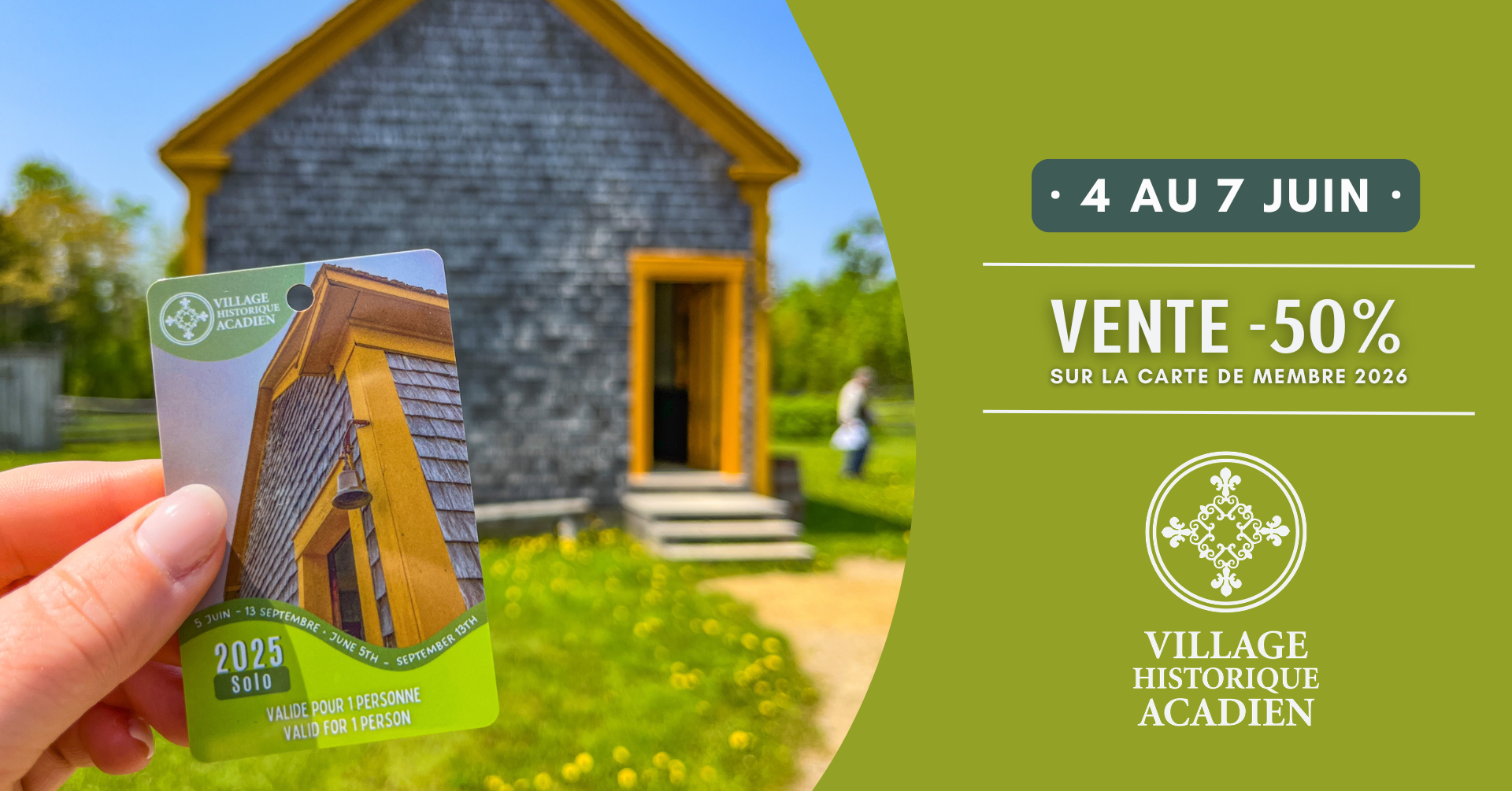
It is this second settlement period that we recreate with our historic village. As much as was possible, it is the bare-essentials life of those difficult times that we wanted to illustrate. This very deprivation appears to us as a cause for pride, as it stands as a witness to the courage and perseverance our ancestors showed in order to maintain, despite a harsh fate, their identity, their language and their customs.
Today, the Acadians, who at the time of the Deportation numbered hardly fifteen thousand souls, are close to two million. Scattered, many offshoots from the original tree have taken roots under faraway skies. In Louisiana, they are over one million. They are to be found in all Canadian provinces, and in the Falkland Islands, in France, in New England. Many have preserved the memory of their origins and still call themselves Acadians.
But it is chiefly in the Maritime Provinces of Canada - New Brunswick, Nova Scotia, Prince Edward Island - that they have affirmed their identity. It is to this territory, which long ago was called by the sweet name of Acadie, that they remain attached. It is here that they have given themselves a flag, a national anthem, instutions; it is here, more than anywhere else, that they have won back, through their persistence, an important part of the rights they had lost. In New Brunswick, where they comprise one third of the population, their language is one of the two recognized by the government, in the only officially bilingual province in Canada.
We are no longer exiles. If we can today make that assertion with our head held high, without fear of anyone, we owe it to those who lived through the slice of history we illustrate here. It is a tribute we are paying our ancestors, to say how proud we are of what they were able to preserve, of this priceless heritage they have left us, which is called dignity.
|